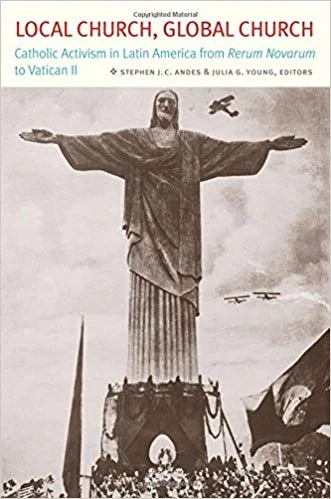
How did Latin America’s Catholic Church respond when revolution became a governing reality? Stephen Andes compares Mexico, Cuba, and Nicaragua, the region’s three successful twentieth-century revolutions, to trace Catholicism’s shifting place in insurgency, counterrevolution, and state formation. He argues that anticlericalism, agrarian reform, and secular public education repeatedly pushed bishops and lay Catholics toward opposition, while the strength and internal unity of each national church shaped the form that resistance took.
The chapter also follows the reforms of Vatican II and Medellín, the rise of liberation theology, and the emergence of Nicaragua’s “popular church.” Across these cases, Catholicism appears neither uniformly conservative nor revolutionary, but as a divided institution whose political choices were shaped by theology, social conflict, and the struggle for survival.
Stephen J. C. Andes · The Oxford Handbook of Latin American Christianity, pp. 175–193
DOI: 10.1093/oxfordhb/9780199860357.013.8
Follow the source.
From the archive: an editorial summary with a link to the original. Downloads supplied by Stephen Andes; available above.